
50 YEARS ON
6 October 1976
On the morning of 6 October 1976, police and armed civilians massacred students and members of the public at Thammasat University, Tha Prachan. We remember them.
This page describes killing and violence against students. None of the photographs shown on this page depict the dead.
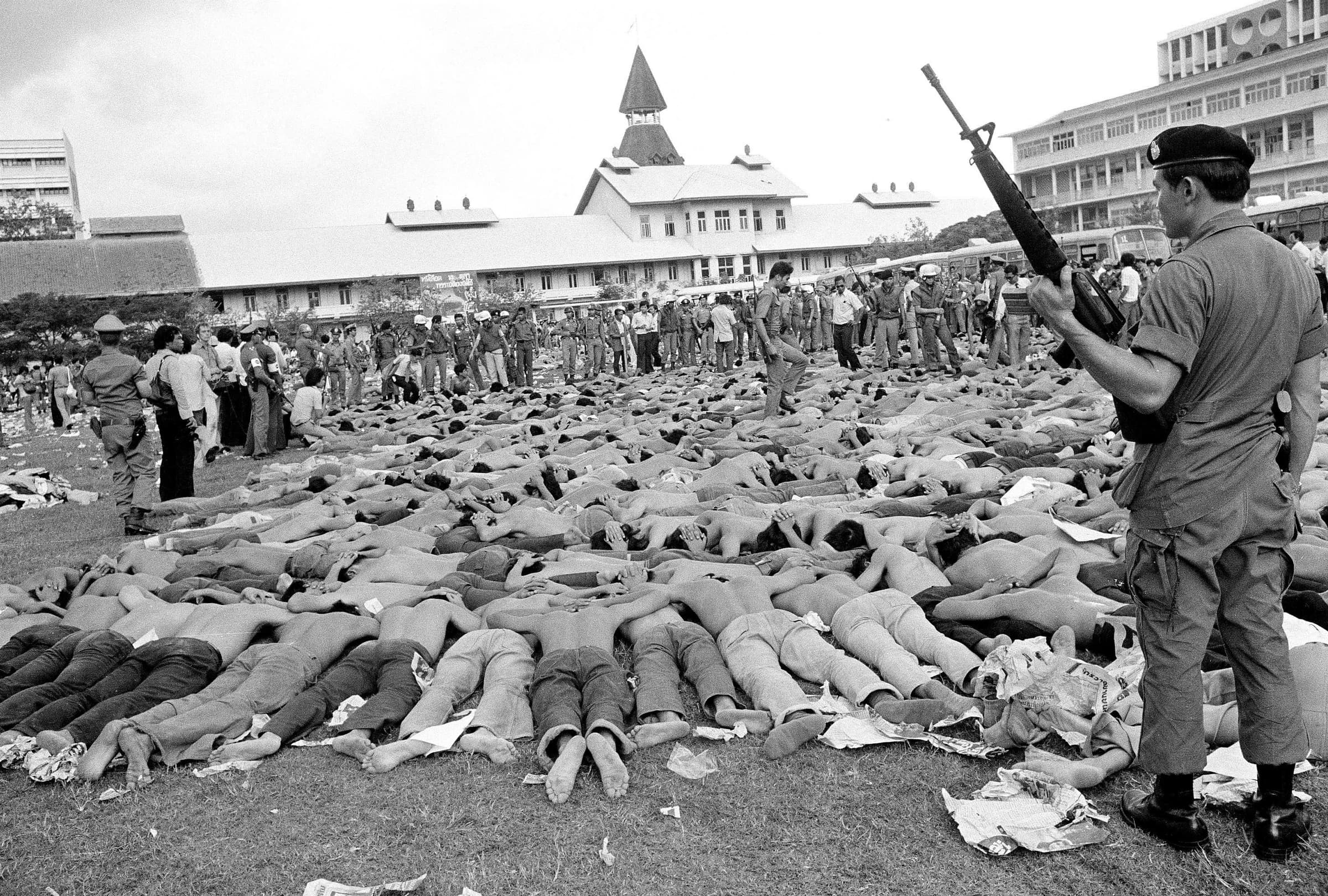
Behind the title, the football field of Thammasat University on the morning of 6 October 1976, with the Dome behind. Photograph by The Associated Press, published by Khaosod. View on Khaosod (opens in a new tab)
“I scoff at sorrow, at the thorns and bitter trial; man yet stands tall, magnificent in defiance.”
“ขอเยาะเย้ยทุกข์ยากขวากหนามลำเค็ญ คนยังคง ยืนเด่นโดยท้าทาย”
Fifty years on
Tens of thousands of students and members of the public had gathered at Thammasat to protest against the return of Thanom Kittikachorn. Before dawn, Border Patrol Police surrounded the university, and then poured fire into it. The 3,094 people who survived the killing were all arrested that same day. That evening, the military seized power and restored dictatorship.
The dead are too often remembered only as a number, and some still have no name. Tha Prachan is where we study today. It is also where this happened.
How it came to this
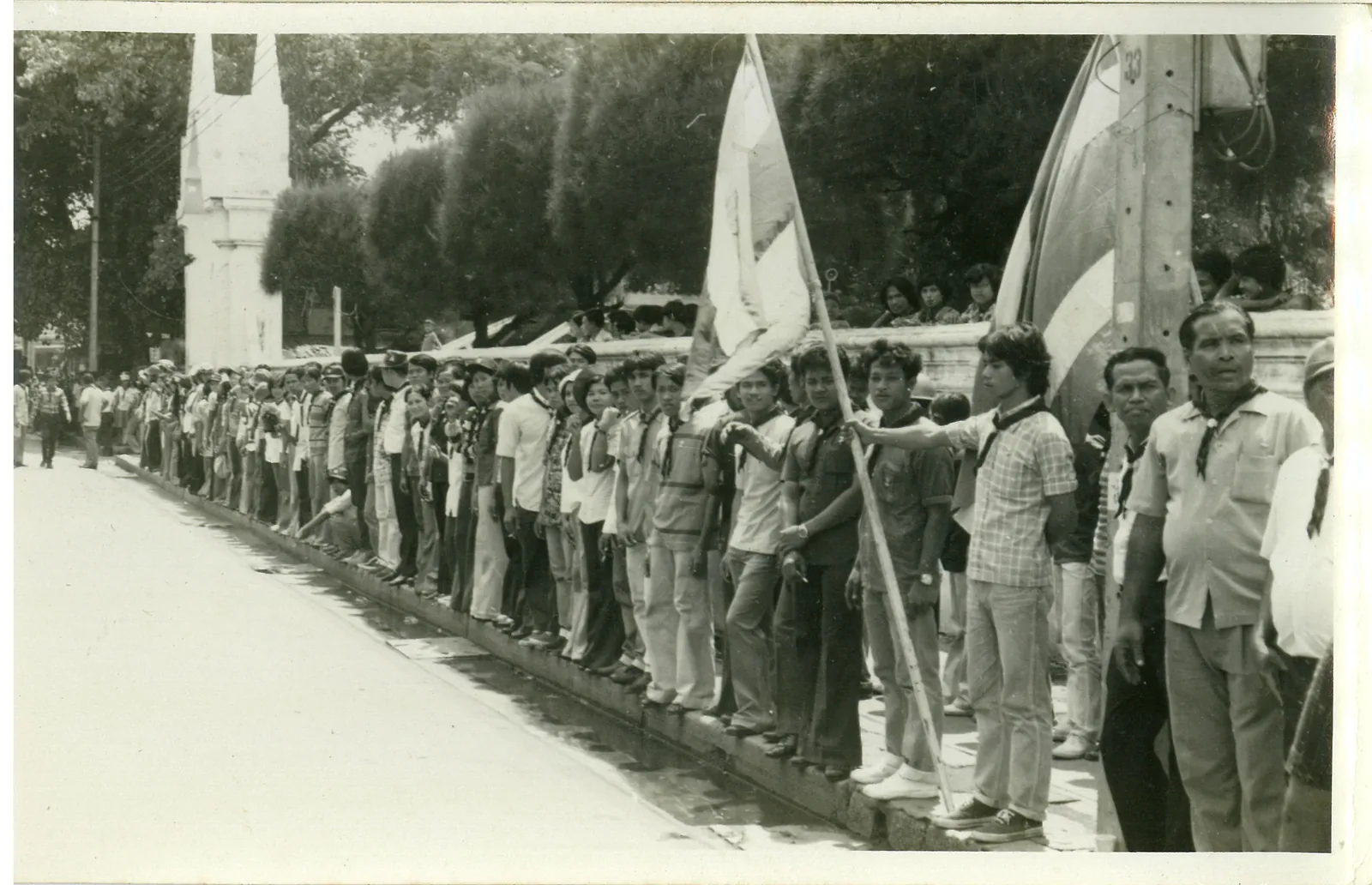
The origins of the massacre can be traced back to 14 October 1973, when the student movement won its struggle and brought the greatest democratic awakening in Thai history. Right wing groups grew in response. They included the Village Scouts, the Red Gaurs and Nawaphon, and parts of the state stood behind them.
On 19 September 1976 Field Marshal Thanom Kittikachorn came home from Singapore as a novice and was ordained a monk at Wat Bowonniwet. On 24 September two Nakhon Pathom electricity workers were beaten to death while putting up posters against him, and their bodies were hanged at the gate of a housing estate.
On 4 October students rallied at Lan Pho, and the Thammasat drama club staged a play about the Nakhon Pathom hanging. The next day the Dao Siam newspaper used a photograph of the play to attack the student movement, claiming the students had deliberately insulted the monarchy.
What happened
The times follow the timeline Documentation of Oct 6 compiled from the records of the day. The words are those of the people who were there, and of the families who lost them.
Tuesday 5 October 1976
The night before
10.00
Yan Kraw army radio runs a special programme. Its presenter repeats that the rally at Thammasat is no longer against Thanom, but an insult to the monarchy.
“Yan Kraw radio therefore began joining forces with the managers of two hundred and sixty radio stations and many presenters, the Free Radio Association and an enormous mass base, whose listeners were a force taking part in the operation.”
“สถานีวิทยุยานเกราะจึงได้เริ่มผนึกกำลังกับผู้บริหารสถานีวิทยุต่าง ๆ สองร้อยหกสิบสถานี พร้อมกับผู้จัดรายการจำนวนมาก ซึ่งเป็นชมรมวิทยุเสรีและด้านมวลชนมหาศาล ซึ่งเป็นผู้ฟังเป็นกำลังร่วมปฏิบัติการ”
13.30
Ramkhamhaeng students prepare to set out for Thammasat in 25 vehicles.
Evening
The rally swells to tens of thousands and moves from Lan Pho to the football field.
“By evening I still had not eaten, and it seemed nobody in the club room had eaten supper. We shared out snacks.”
“จนตกเย็น ฉันก็ ยังไม่ได้กินข้าว และดูเหมือนไม่มีใครในห้องชมรมได้กินข้าวเย็น เราเอาขนมของขบเคี้ยวมาแบ่งกันกิน”
20.35
For the first time, Yan Kraw and the Free Radio Association call the students and people at Thammasat “troublemakers”, and say there “may be bloodshed”.
21.30
The National Student Centre of Thailand brings the two student actors before the press to show their innocence.
All night
Yan Kraw and the Free Radio Association broadcast through the night, calling on the public and the Village Scouts to gather at the Royal Plaza.
Wednesday 6 October, before dawn
The first shots
01.40
About 100 people burn posters at the Sanam Luang gate of the university. The first shot rings out. Scattered shots follow, but no one is hurt.
04.00
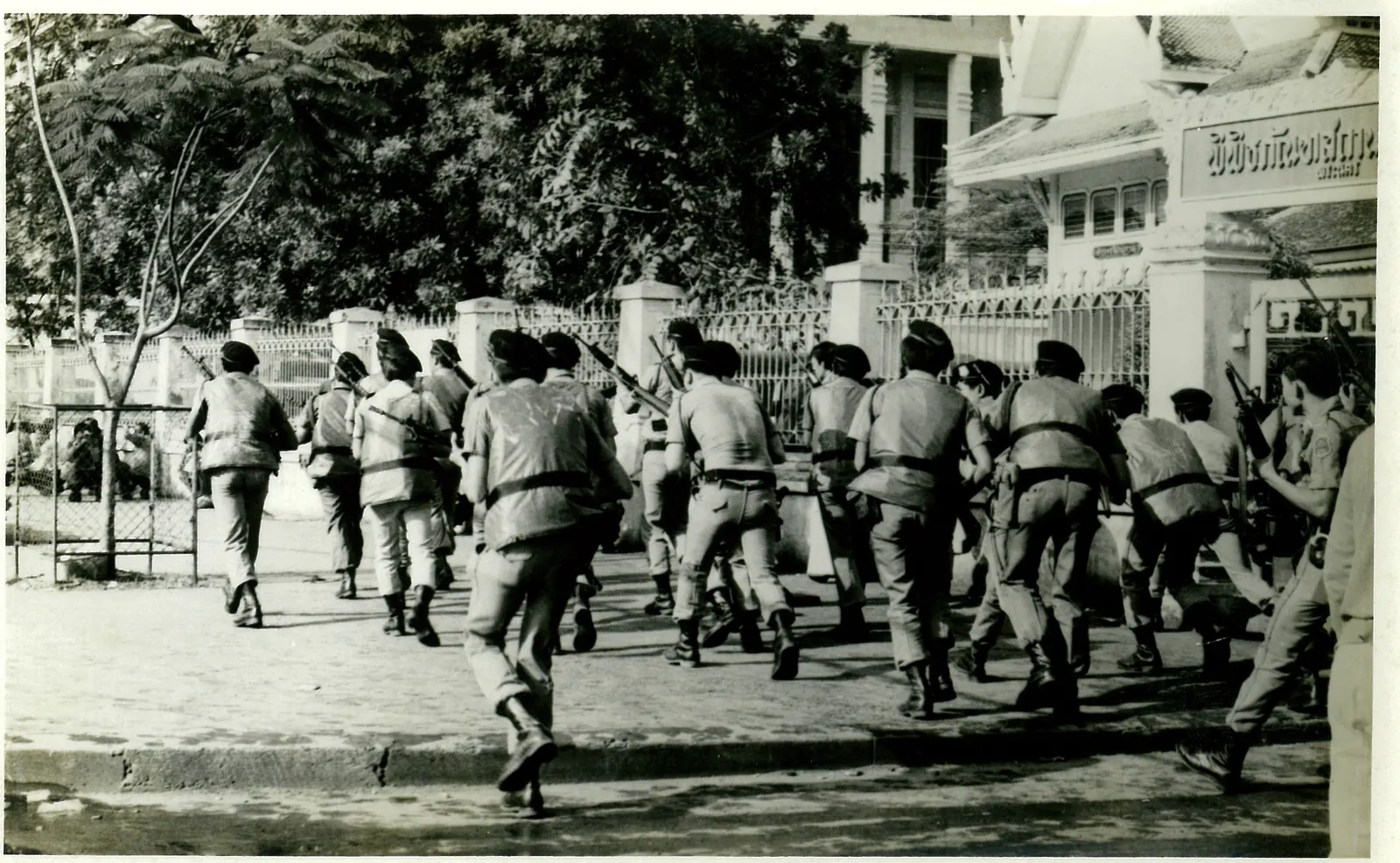
Border Patrol Police from Naresuan camp, Hua Hin, arrive, surround the university from the Sanam Luang side, and post armed men in the National Museum.
“I had dozed off, and I woke with a violent start at a ‘boom’ so loud the whole building shook.”
“ฉันง่วงหลับไปและมาสะดุ้งสุดตัวตื่นขึ้น ด้วยเสียง ‘ตูม’ ที่ดังสนั่นหวั่นไหวจนตึกสะเทือน”
05.30
The first M79 grenade, fired by police outside the university, lands among the crowd on the football field. Four people are killed and others are wounded.
“At half past five, when the bomb came down, I saw people lying all across the ground. Then someone came to tell me ten or more were dead, and others wounded.”
“ตี 5 ครึ่ง น. พอระเบิดลงเห็นคนนอนเป็นแพ แล้วก็มีคนมาบอกว่าตายเป็นสิบ บาดเจ็บจำนวนหนึ่ง”
6 October, from 07.00
Under fire
07.00
Police pour heavy fire into the university from the Great Hall and the National Museum. Thousands shelter in the buildings around the football field. Dozens are killed.
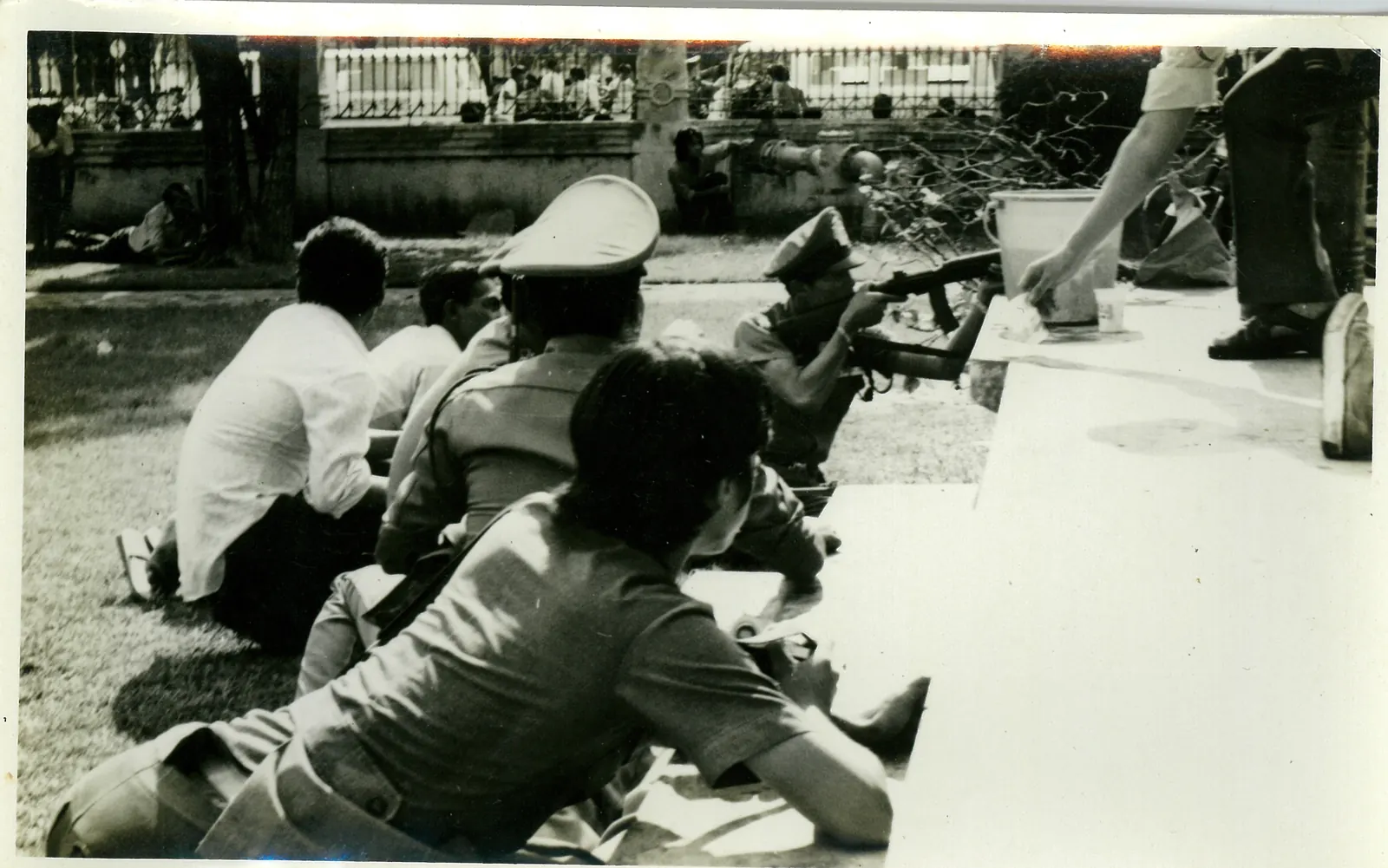
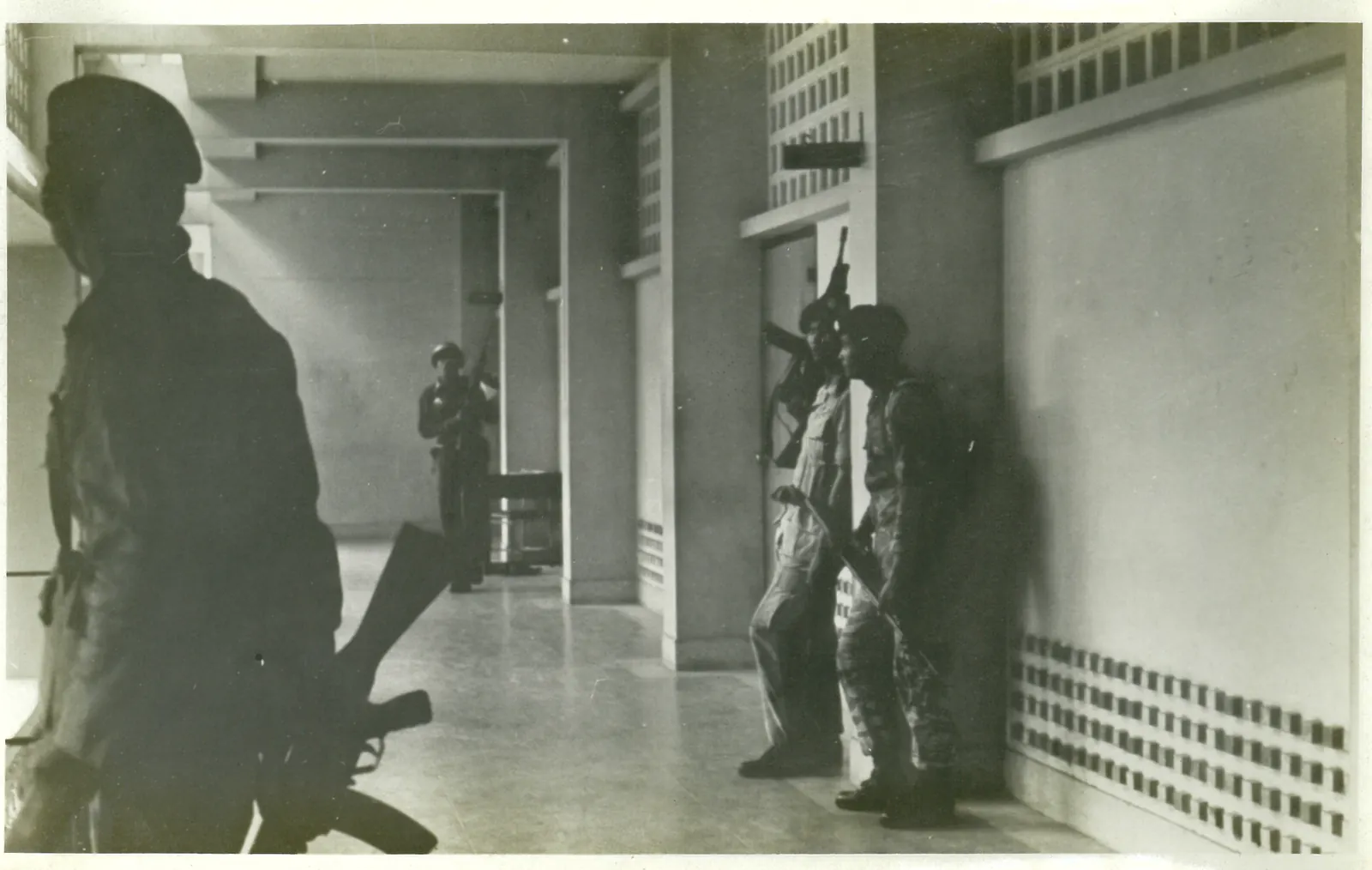
“‘Stop firing! Please stop firing! We have no weapons. We have nothing. Brothers in the army, brothers in the police, let us out…’ The voice was hoarse and trembling, and it wrung my heart.”
“‘หยุดยิง ! หยุดยิงครับ พวกเราไม่มีอาวุธ เราไม่มีอะไร พี่ๆทหารครับ พี่ๆตำรวจครับ ให้พวกเราออกไป…’ เสียงนั้นแหบแห้งสั่นเครือ บีบคั้นหัวใจฉันยิ่งนัก”
“I caught sight of a schoolgirl in her sailor collar uniform, huddled in the corner of the building with her face in her hands, sobbing. I pulled her to me and held her, and we cried together.”
“ฉันเหลือบเห็นเด็กผู้หญิงในชุดนักเรียนคอซอง นั่งปิดหน้าซุกตัวร้องไห้โฮๆกับมุมตึก ฉันรีบคว้าตัวน้องมากอดไว้ แล้วเราก็ร้องไห้ด้วยกัน”
07.00
Outside, the crowd at the gate drives two buses into it to force a way in.
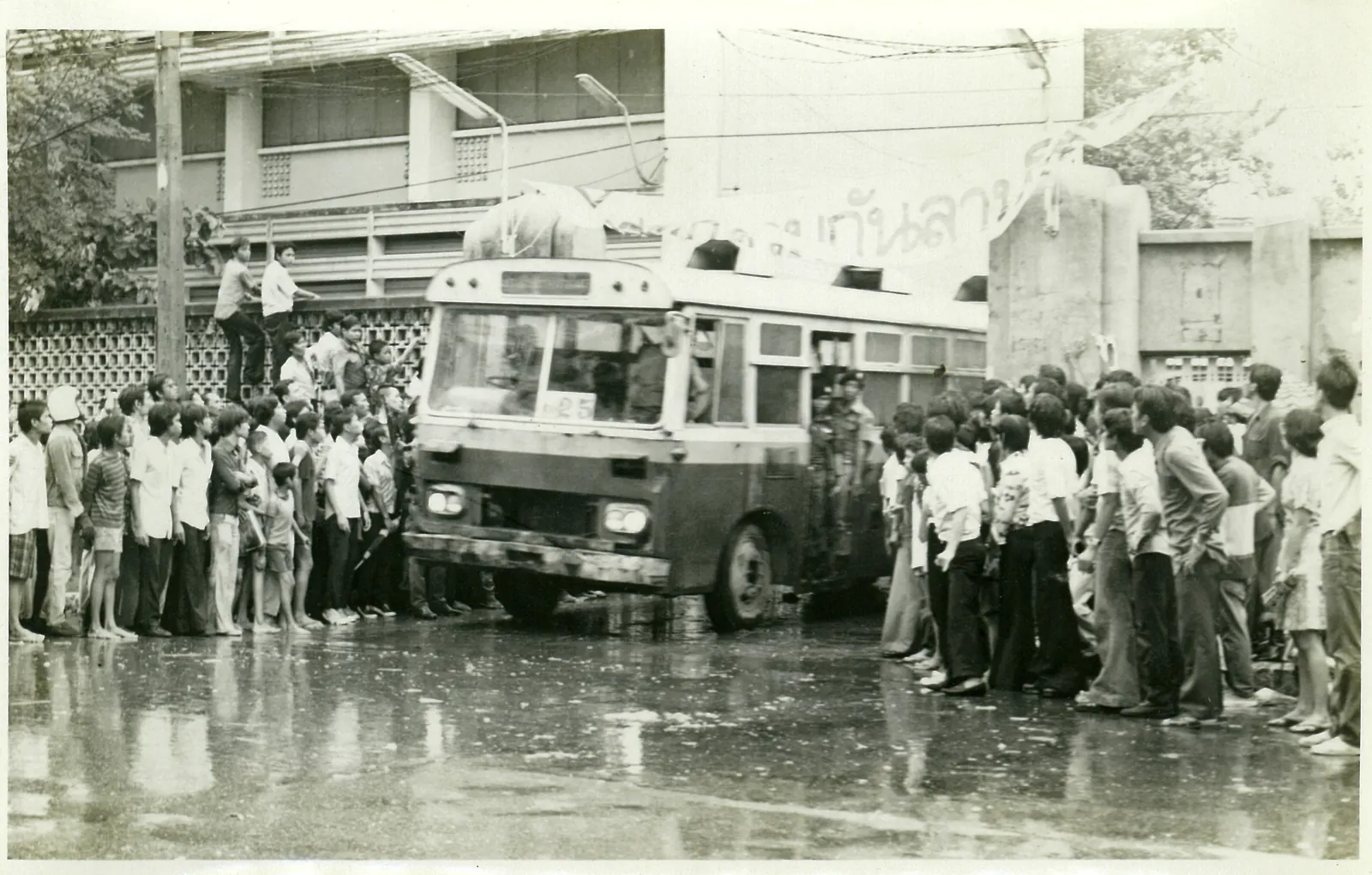
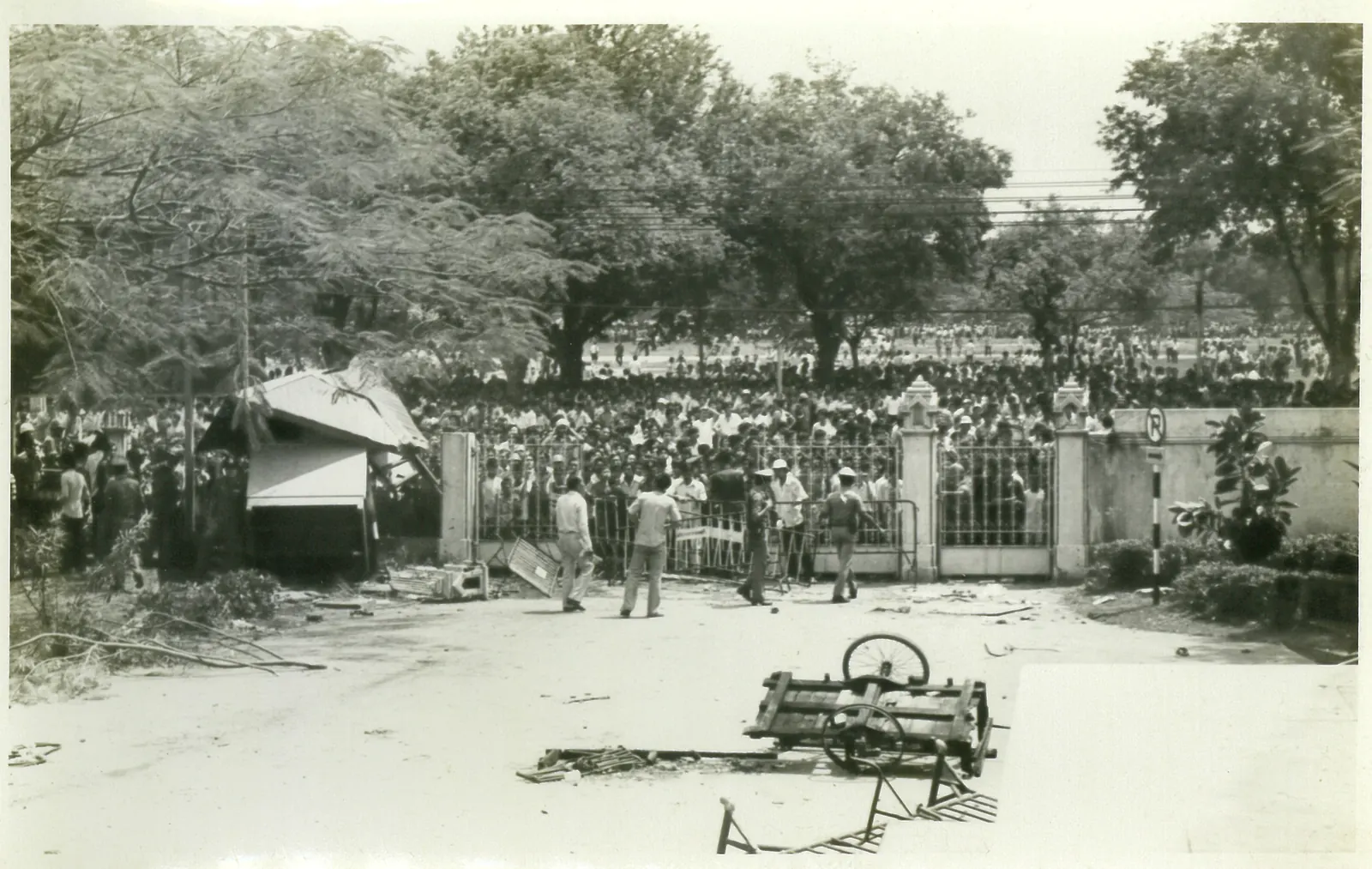
“The river police shouted that the Thammasat students who had fled must come back ashore at once, or they would shoot. We were terrified. A male student took off his shirt and called out that we surrendered. Before he had finished, a single shot rang out, and someone shouted that a person had been hit.”
“มีเสียงตำรวจน้ำตะโกนบอกว่า นักศึกษาธรรมศาสตร์ที่หนีออกนั้นให้กลับขึ้นฝั่งเดี๋ยวนี้ ไม่งั้นจะยิง พวกเรากลัวกันมาก มีเพื่อนนักศึกษาชายถอดเสื้อ บอกไปว่า พวกเรายอมแพ้แล้วนะ ไม่ทันขาดคำ แป๊บเดียวเสียงปืนดังมาหนึ่งนัด มีเสียงตะโกนว่ามีคนถูกยิง”
07.50
Commandos, the Special Operations Unit and local police ring the university. Police Lieutenant General Chumphon Lohachala and Police Major Generals Sanae Sitthiphan and Yutthana Wannakowit arrive and join the command.
6 October, from 08.10
Surrender
08.10
Police Major General Sanae Sitthiphan orders armed Border Patrol Police to prepare to enter the university. Gunfire is constant. Police tell the students to surrender. Several try to run out, and the people waiting outside lynch them.
08.18
Border Patrol Police take over from the local police, and two more vehicles of reinforcements arrive.
08.25
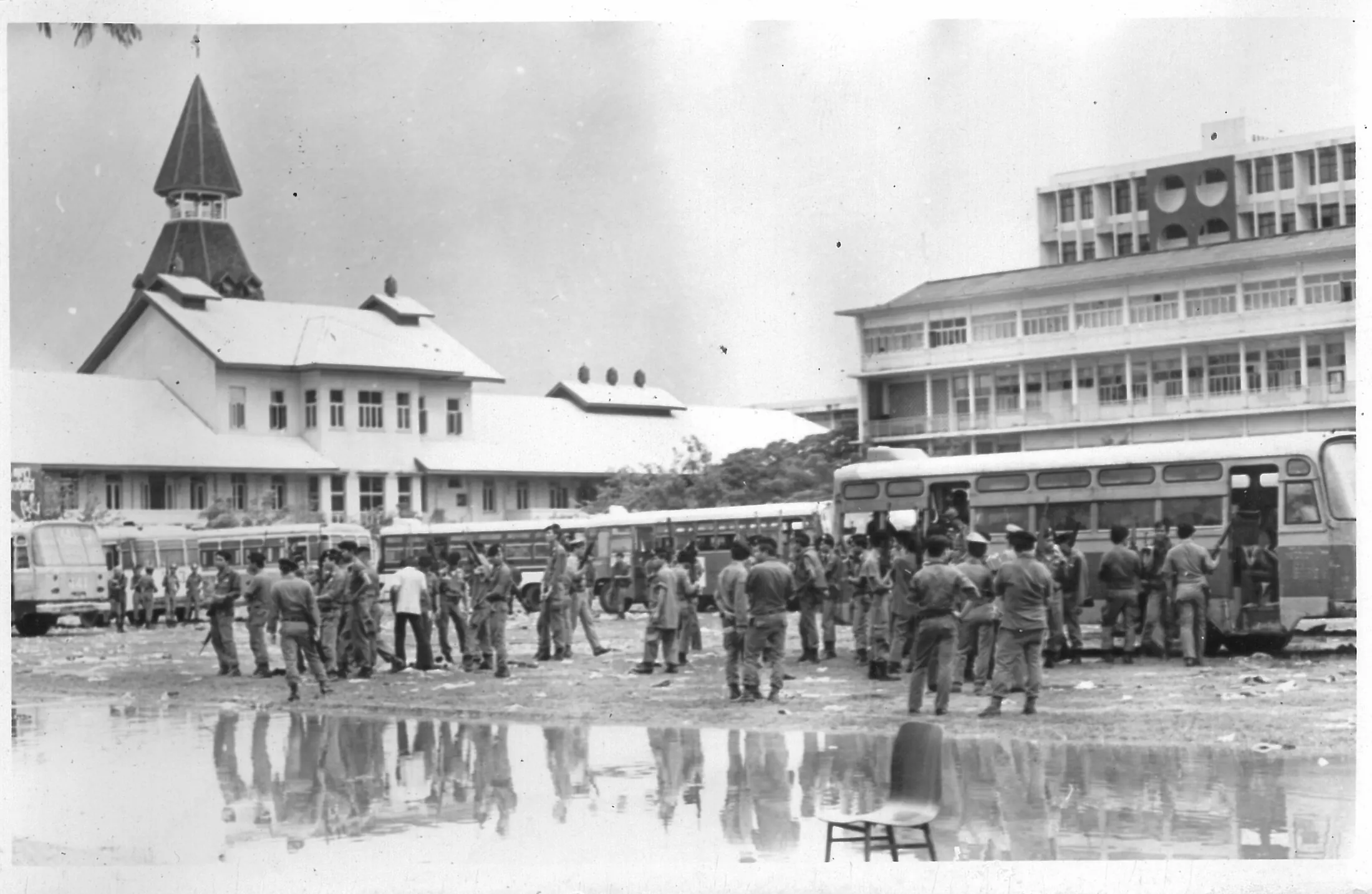
Border Patrol Police break into the university and move to seize the protesters sheltering in the buildings around the football field.
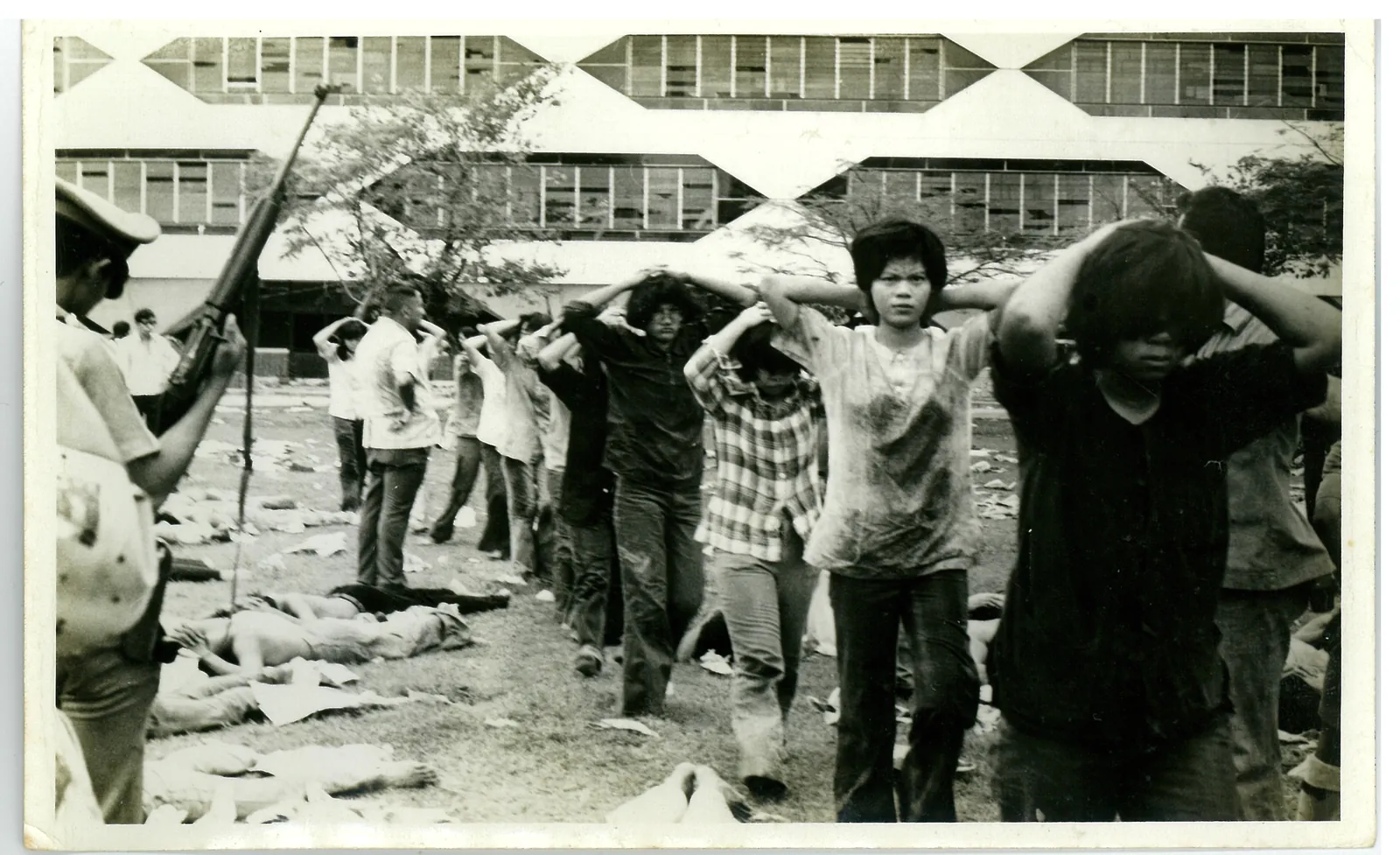
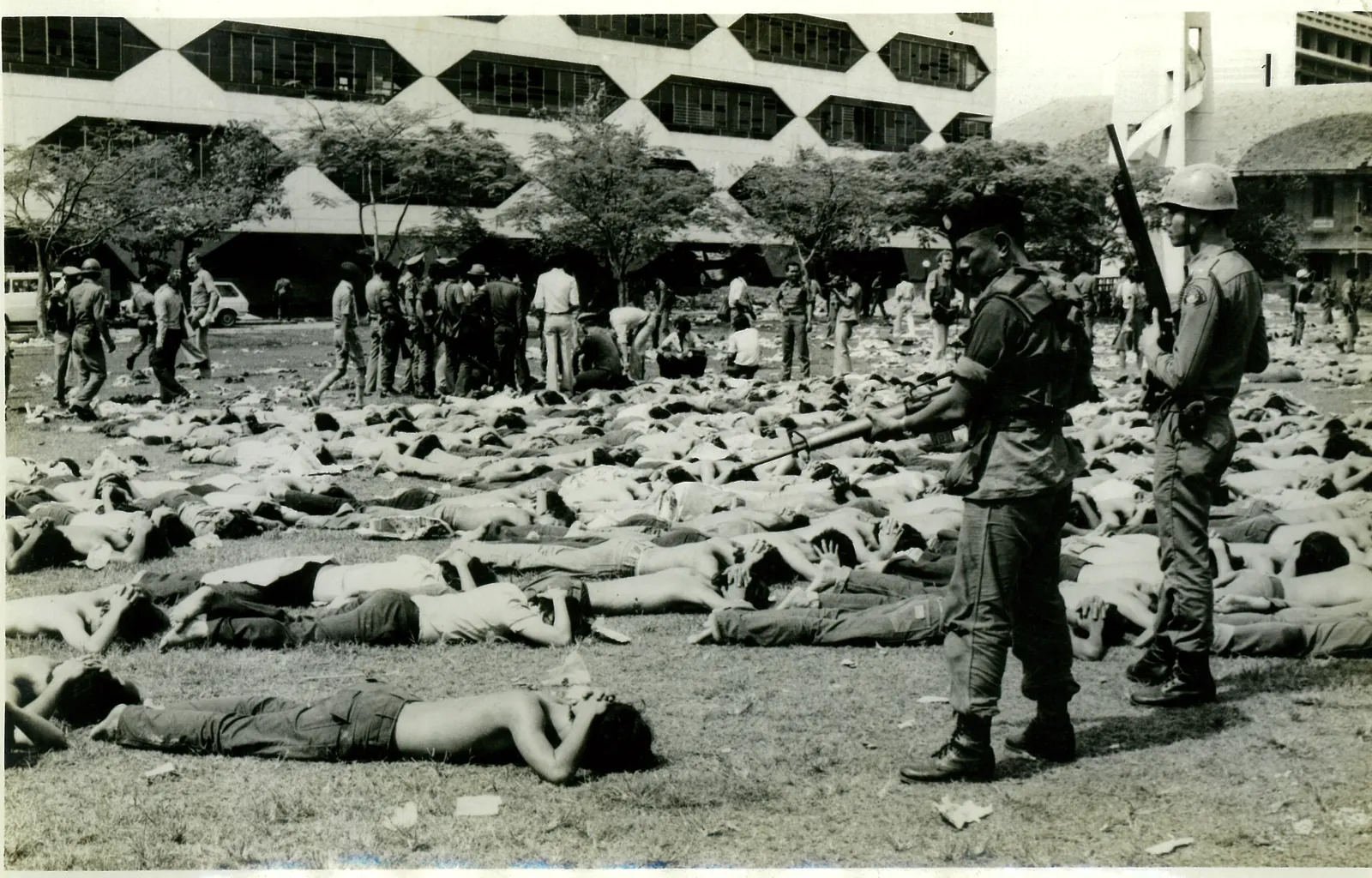
10.30
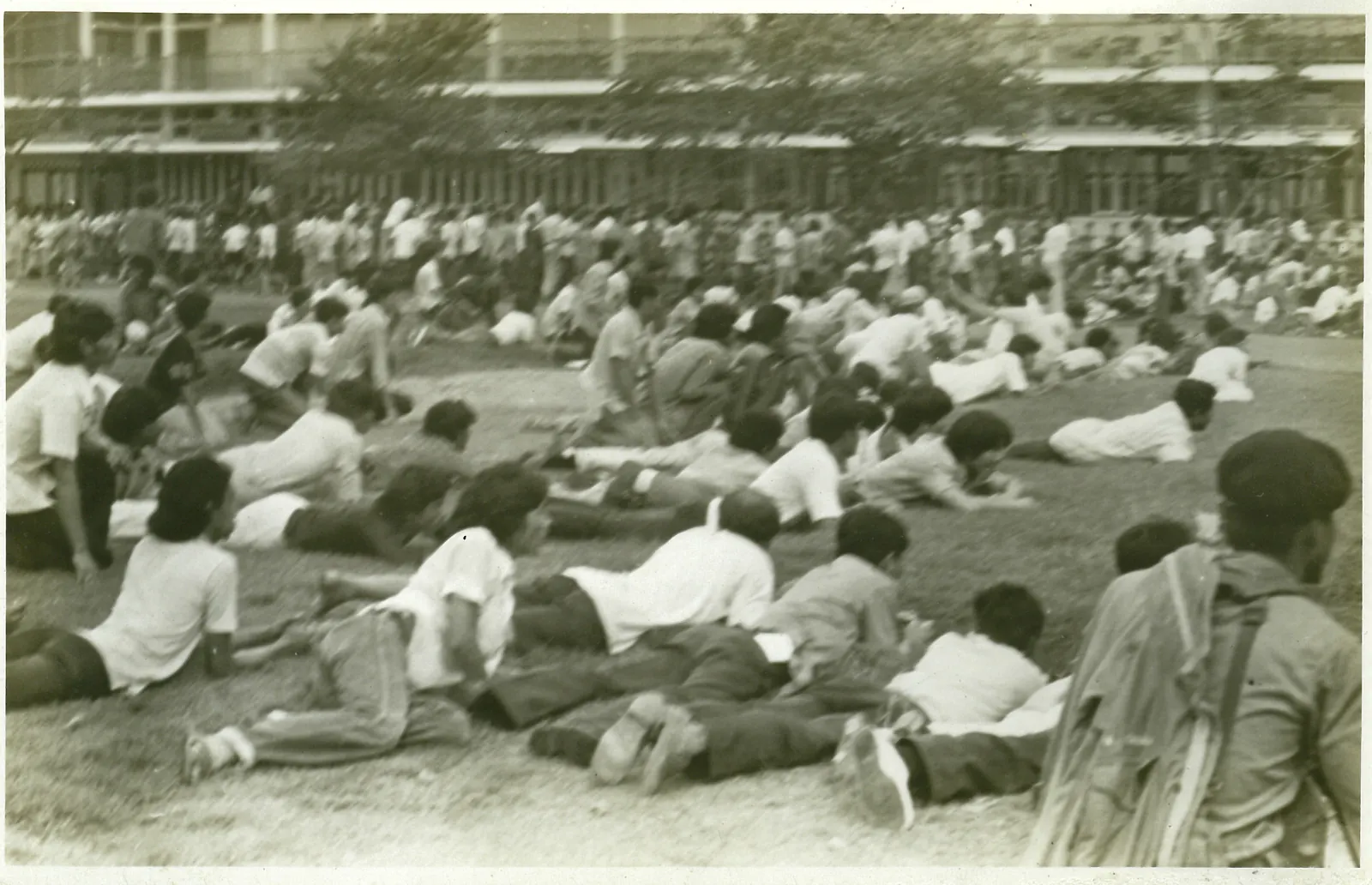
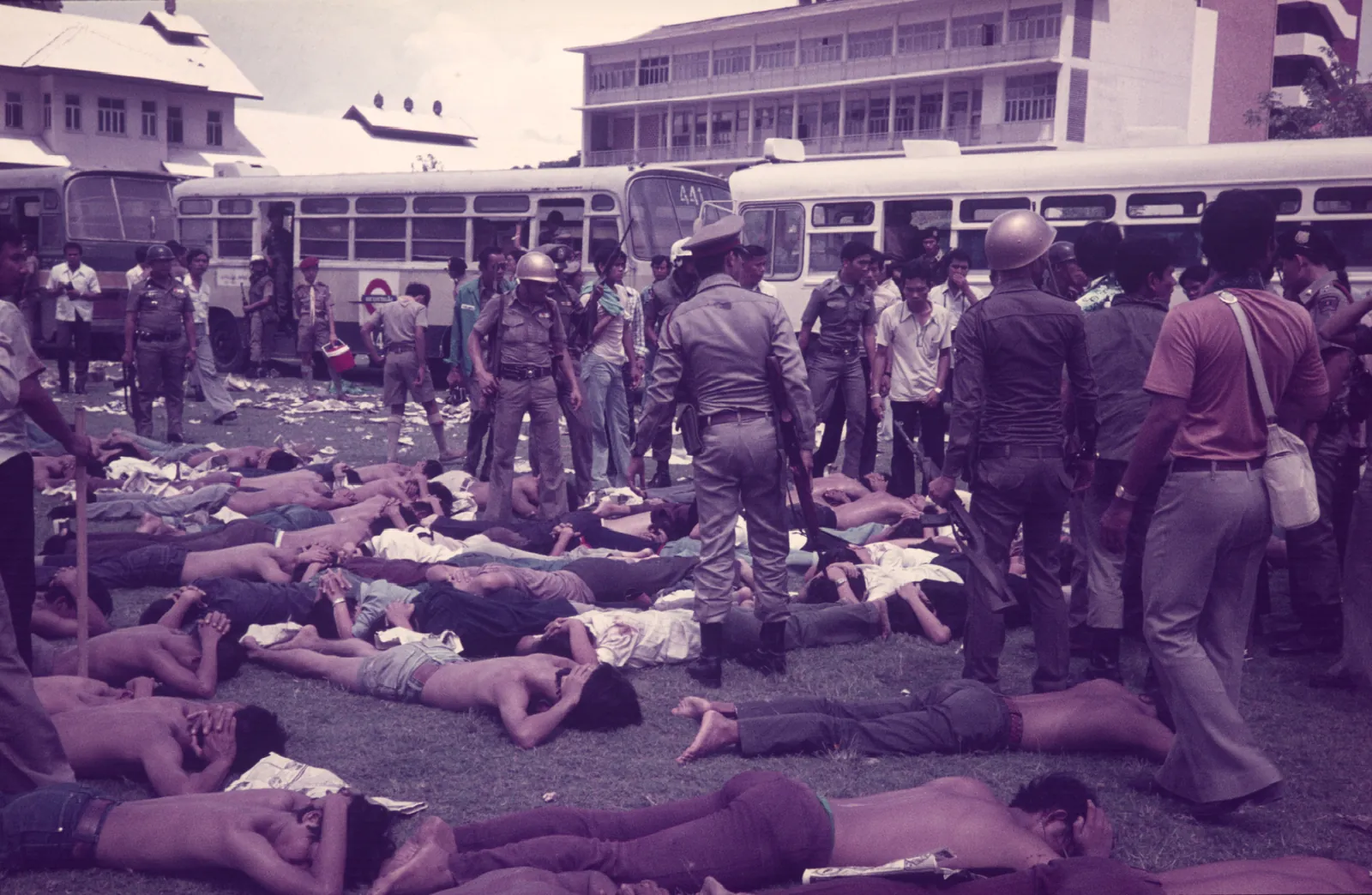
Students and members of the public are ordered to lie face down. Men and women are forced to take off their shirts.
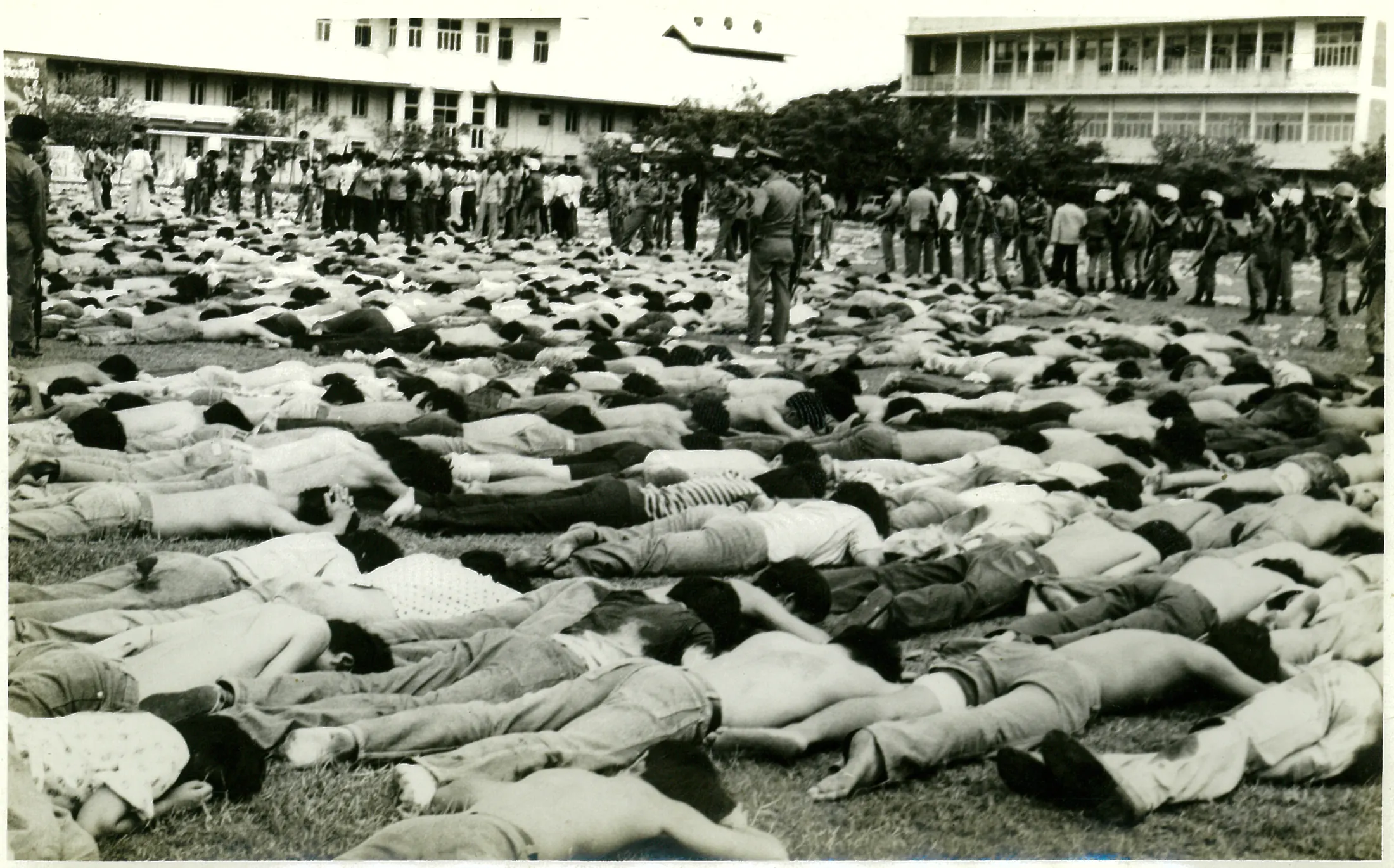
“As you came up out of the water they put a gun to you, made you take off your shirt, and run to gather at Wat Mahathat.”
“เวลาขึ้นจากน้ำก็เอาปืนจี้ บังคับให้คุณถอดเสื้อแล้ววิ่งไปรวมกันอยู่ที่ วัดมหาธาตุ”
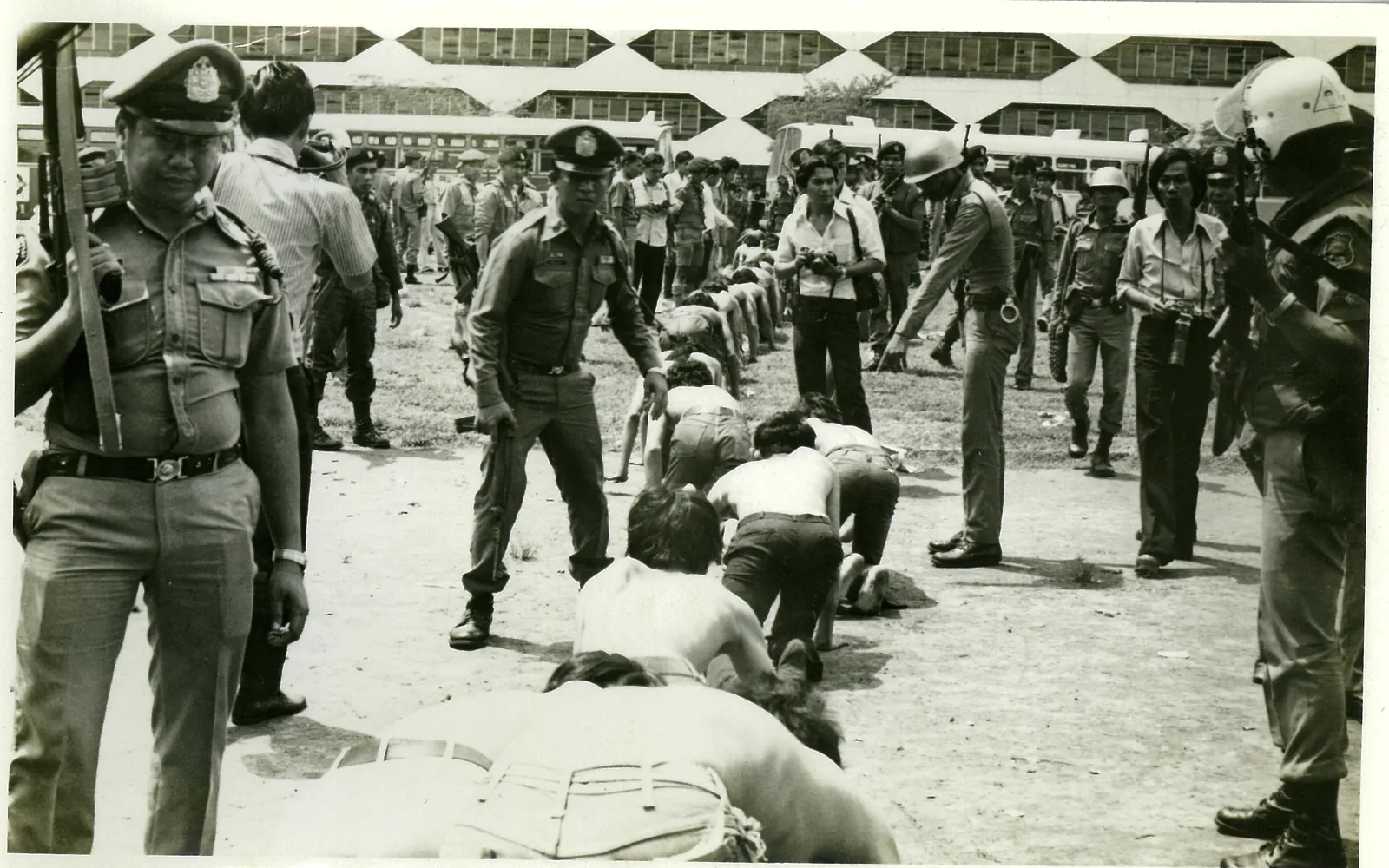
10.30
Women students are left in their bras, ordered to put their hands on their heads and crawl along the ground, and police kick them as they crawl.
6 October, late morning
Taken away
10.30
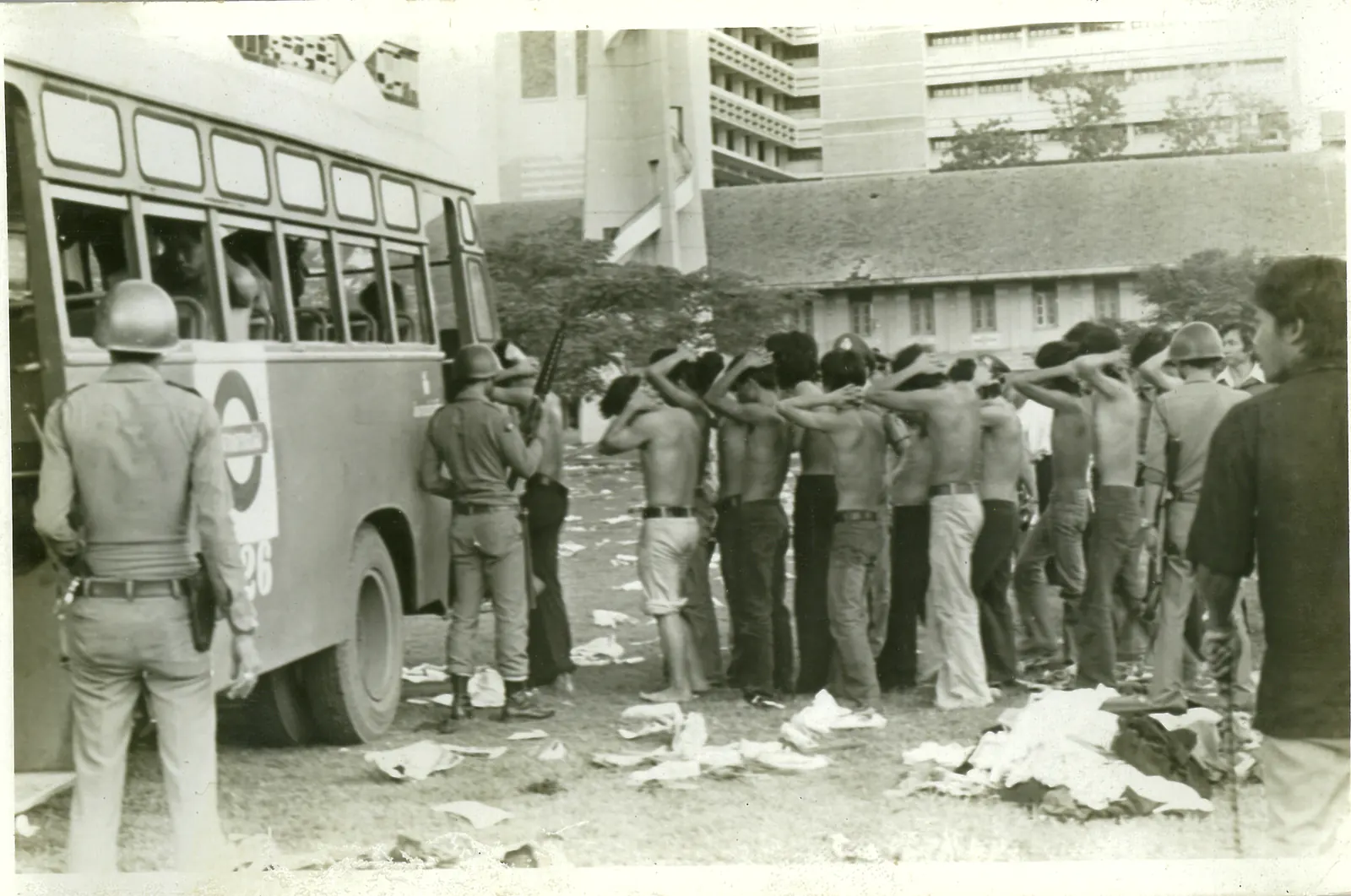
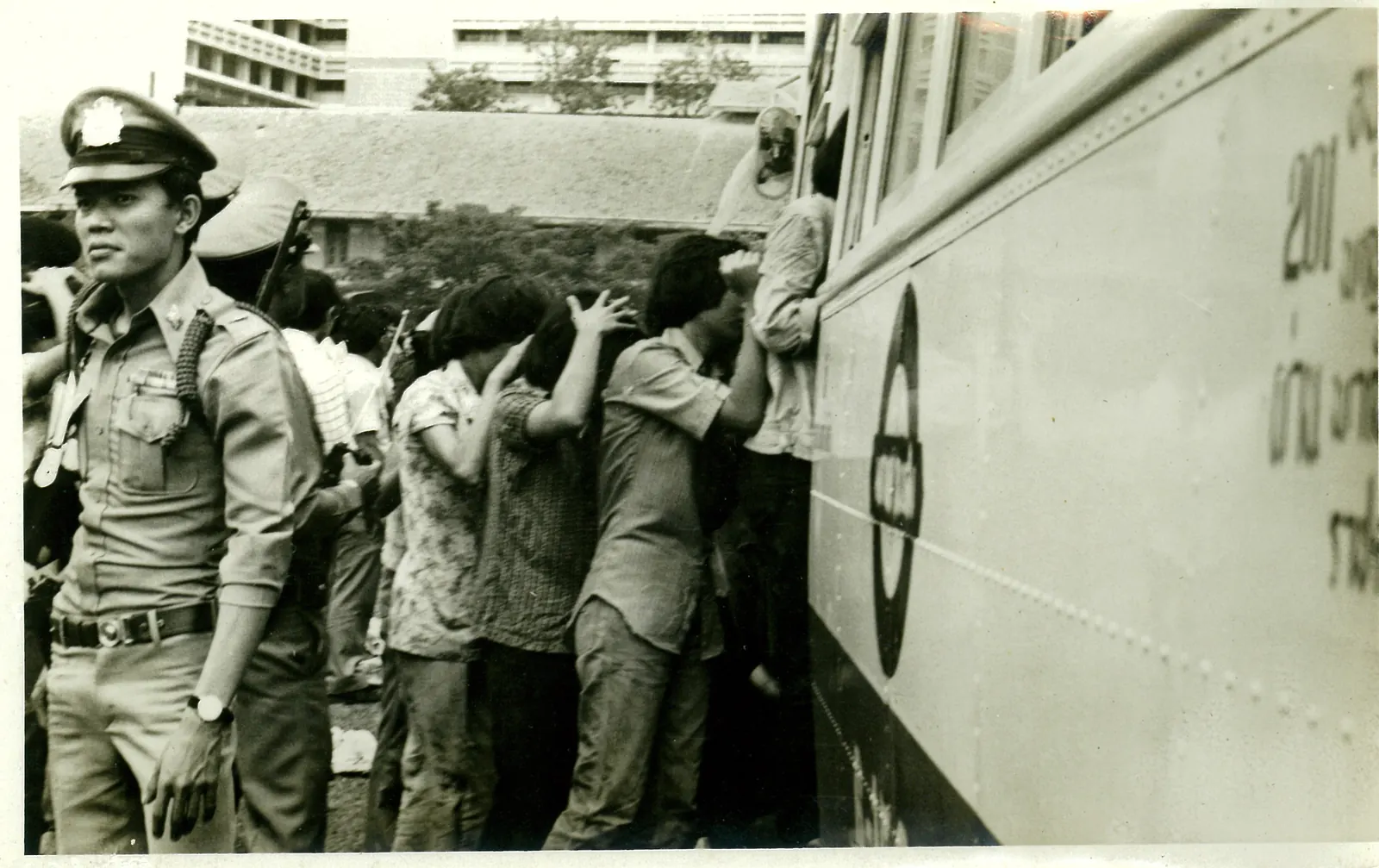
They are loaded onto buses and trucks and taken to be locked up at police stations, the largest at Nakhon Pathom, Chonburi and the Bang Khen police school. By the end of the day, 3,094 people have been arrested.
10.30
As they climb onto the vehicles they are cursed, pelted with objects and kicked by police, Red Gaur thugs and Village Scouts. As they step down at the places where they are locked up, police rob them of their belongings and valuables.
“Then I was locked up at Bang Khen with about three thousand of my friends, and it was there that I heard the friend who had been shot was Wimonwan. She had died at Siriraj Hospital.”
“จากนั้น พี่ถูกนำไปขังรวมกันกับเพื่อนๆ อีกประมาณสามพันคนที่บางเขน แล้วก็ได้ข่าวตรงนั้นเองว่า เพื่อนที่ถูกยิงนั้นคือวิมลวรรณซึ่งไปเสียชีวิตที่โรงพยาบาลศิริราช”
6 October, from 10.45
At Sanam Luang
10.45
Preecha Sae Hia is one of five people hanged at Sanam Luang. He is hanged near the Royal Society building, the red building, at about 10.45 to 11.00. The autopsy report shows he was brutally beaten before he died. He was 25.
“I saw that they had already been hanged and that people were going to beat them. I understood they were dead. I stood watching for a short while, then walked across Sanam Luang to find my car. I saw smoke rising and people crowding round, and I saw bodies being burned with car tyres, about three or four of them.”
“เห็นว่าแขวนแล้วและมีคนไปซ้อม ไปทำร้ายก็เข้าใจว่าเขาตายแล้ว ก็ยืนดูอยู่สักประเดี๋ยวหนึ่งก็เดินเลยข้ามสนามหลวงไปหารถ ก็เห็นควันไปขึ้นมีคนมุงดูอยู่ก็เห็นศพถูกเผาโดยยางรถยนต์ ประมาณ 3-4 คน”
6 October, afternoon and evening
The coup
12.30
Tens of thousands of Village Scouts and others rally at the Royal Plaza.
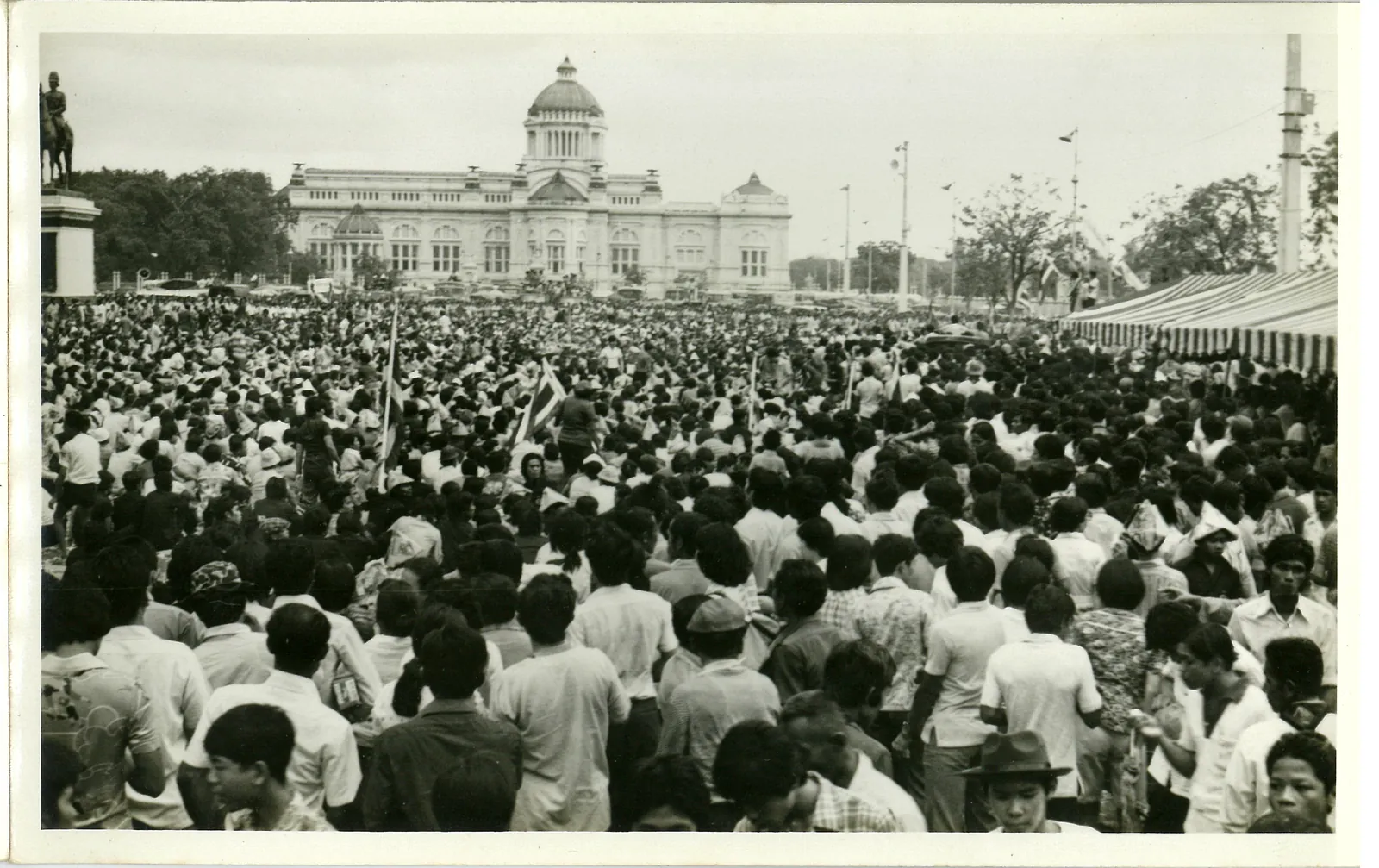
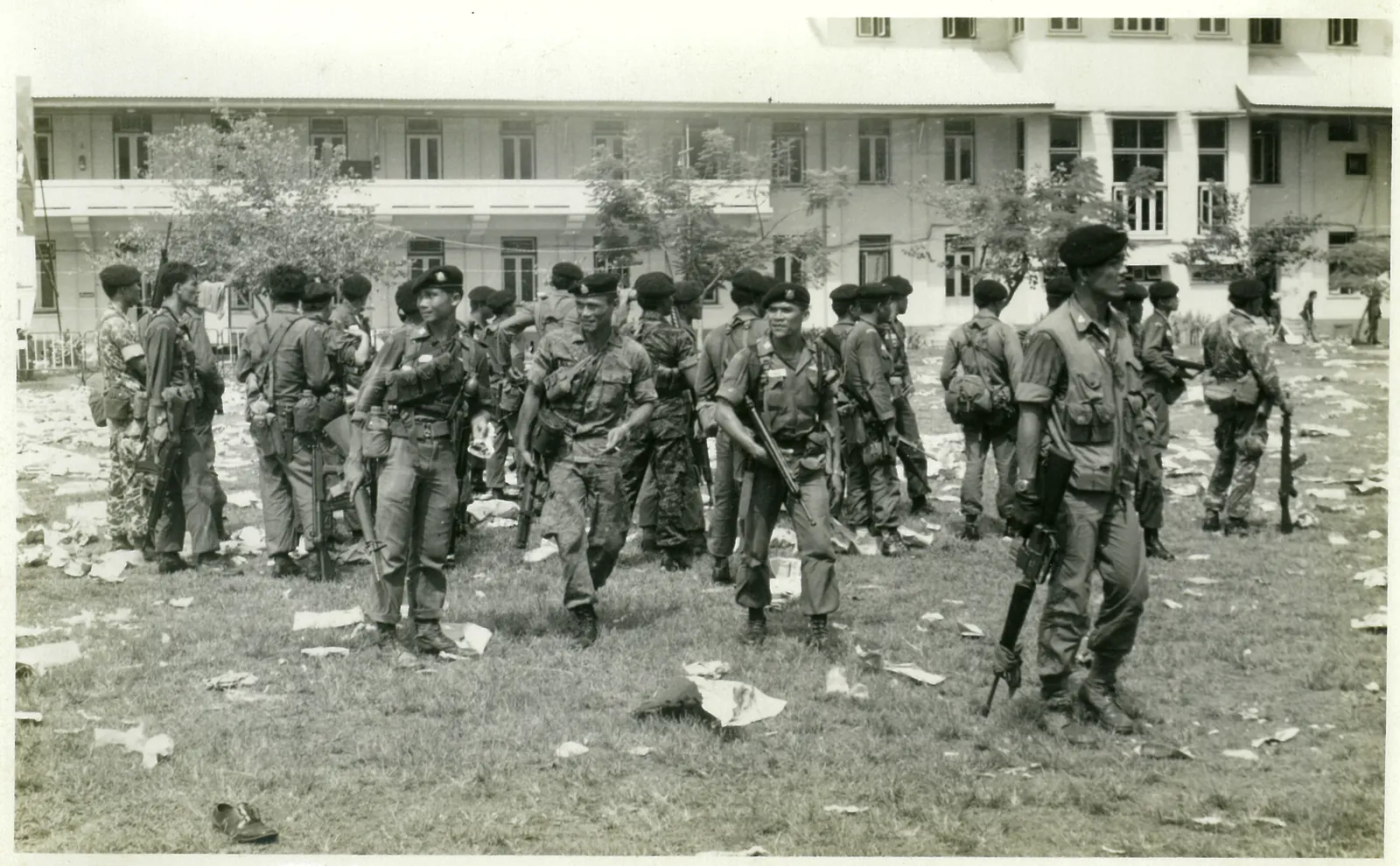
18.00
Admiral Sangad Chaloryu, head of the National Administrative Reform Council, announces that it has seized power.
The days after
The search
“The dead were written down as ‘Thai man, name unknown’. I have never forgotten it, ‘Thai man, name unknown’, because there was no paper, nothing to say who he was. We never thought our brother could have died, because he was clever.”
“คนเสียชีวิตนี่เขาจะเขียนว่าชายไทยไม่ทราบชื่อ ยังจำได้ตลอดว่า ชายไทยไม่ทราบชื่อ เพราะเขาไม่มีหลักฐานไม่มีอะไรที่จะรู้ เราก็ไม่เคยคิดว่าน้องจะเสียชีวิต เพราะเขาเป็นคนฉลาด”
“I could not bring myself to go in. I stood outside. I am a man, but I did not dare. My mother and one of my sisters went in together, because a mother who fears for her child has to go and see.”
“ผมไม่กล้าเข้าไป ผมยืนอยู่ข้างนอก ผมเป็นผู้ชายแต่ผมไม่กล้าไป แม่ผมกับพี่สาวคนหนึ่งเขาเข้าไปดูด้วยกัน ด้วยความที่แม่เป็นห่วงลูก เขาต้องเข้าไปดู”
“They had already caught my son. When I went to collect him, both his shirt sleeves were still tied around his waist. If they had caught him, why kill him? Why shoot? They caught a boy who had done nothing wrong. Who will take responsibility?”
“ความจริงเขาจับลูกแม่แล้วนะ เพราะตอนที่ไปรับศพ แขนเสื้อทั้งสองข้างยังผูกอยู่กับเอว เขาจับแล้วทำไมต้องฆ่ากัน ยิงทำไม เขาจับคนไม่ผิดอย่างนั้น ใครจะรับผิดชอบ”
“Next door, the neighbours' son came home from Bangkok, and I heard them call out, ‘Apisit is here, the boy is here!’ I opened the door and went out. Oh. It was not him.”
“ข้างบ้านนี่ ลูกเขากลับจากกรุงเทพ ได้ยินเสียงเขาเรียกว่า อภิสิทธิ์มา ไอ้น้องมาเว้ยๆ เปิดประตูออกไป อ้าว ไม่ใช่”
“I see tens of thousands, hundreds of thousands of people, but my own child I never see. Why will he not come out, just once, and let his mother see him?”
“เห็นคนหมื่น คนแสน แต่ลูกเรา เราไม่เห็นว่าไปไหน ทำไมมันไม่ออกให้แม่เห็นสักที”
“We all looked at one another and nobody spoke. Many were crying, but nobody said anything or talked it over. In those days the fear was very great.”
“เราต่างก็มองหน้ากันแล้วก็ไม่มีใครพูด แต่หลายคนเขาก็ร้องไห้ แต่ก็ไม่มีใครพูดอะไร หรือปรึกษาหารือกัน ในยุคสมัยนั้นความหวาดกลัวมันสูงมาก”
What came after
Police arrested 3,094 people that day, 2,432 men and 662 women. The 6 October defendants were held and tried for almost two years. On 16 September 1978 all 18 defendants, and one more in the criminal court, were amnestied and freed.
The coup group made Thanin Kraivichien prime minister. Many students fled to the jungle. When General Kriangsak Chamanan's government released the defendants, he told the country to let bygones be bygones and “forget it”.
“Most astonishing of all, for all this bloodshed, not a single one of the killers was ever arrested.”
“แต่ที่น่าประหลาดใจที่สุดก็คือ การก่อกรณีนองเลือดครั้งนี้ ไม่มีการจับกุมฆาตกรผู้ก่อการสังหารเลยแม้แต่คนเดียว”
Victims of the violence
“To come to know who the victims were is to honour their humanity.”
“การทำความรู้จักตัวตนของเหยื่อก็คือการแสดงความเคารพต่อความเป็นมนุษย์ของพวกเขา”
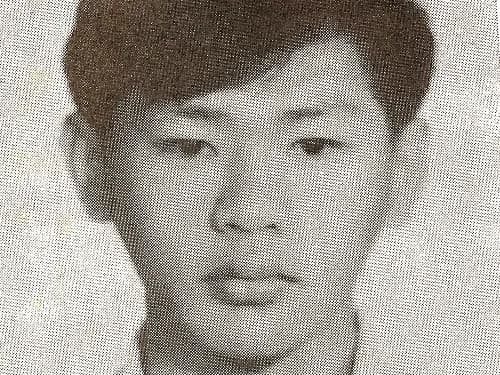
Wichitchai Amornkul
19. A second year Political Science student at Chulalongkorn University, from Ubon Ratchathani.
Photograph from Documentation of Oct 6, which does not name the photographer. Read about Wichitchai Amornkul (opens in a new tab)
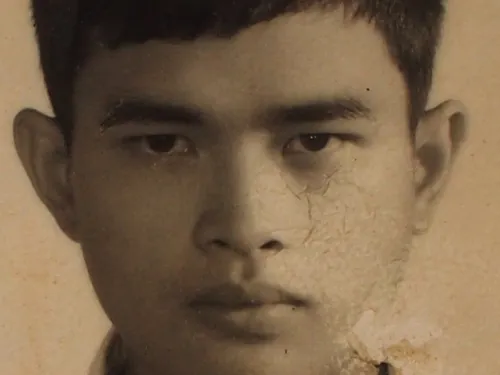
Jarupong Thongsin
19. A third year Liberal Arts student at Thammasat. His parents, Chinda and Lim, searched the country for their son.
Photograph from Documentation of Oct 6, which does not name the photographer. Read about Jarupong Thongsin (opens in a new tab)
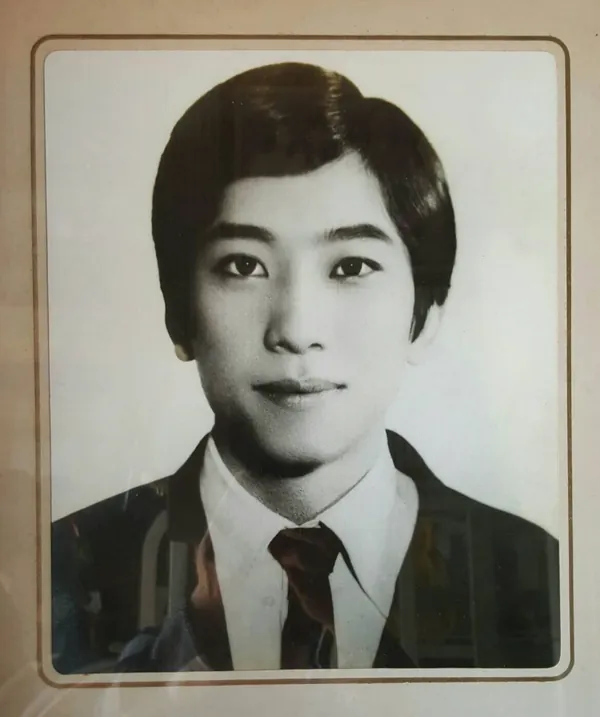
Supol Phan
24. From Udon Thani. He was shot while trying to drive the wounded to hospital.
Photograph from Documentation of Oct 6, which does not name the photographer. Read about Supol Phan (opens in a new tab)
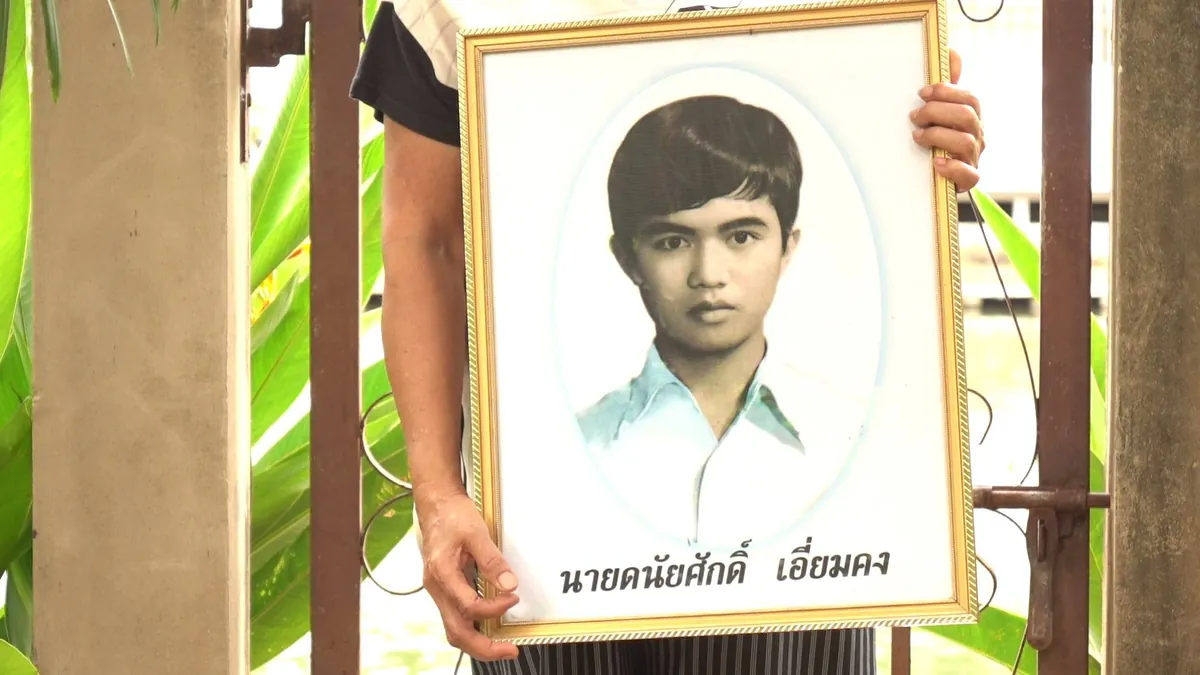
Danaisak Iamkhong
21. A Political Science student at Ramkhamhaeng University, from Nakhon Si Thammarat.
Photograph from Documentation of Oct 6, which does not name the photographer. Read about Danaisak Iamkhong (opens in a new tab)
These are the 40 students and members of the public who died in the massacre.
- วิชิตชัย อมรกุล (opens in a new tab)Aged 19. Second year Political Science, Chulalongkorn University
- อรุณี ขำบุญเกิด (opens in a new tab)Aged 19. Ramkhamhaeng University student, from Chumphon
- ปรีชา แซ่เฮีย (หรือแซ่เอีย) (opens in a new tab)Aged 25. Editorial and distribution staff, Asia Wikhro Khao magazine
- วิมลวรรณ รุ่งทองใบสุรีย์ (opens in a new tab)Aged 20. Third year nursing, Ramathibodi School of Nursing
- เนาวรัตน์ ศิริรังษี (opens in a new tab)Aged 23. Business Administration, Ramkhamhaeng University
- ภูมิศักดิ์ ศิระศุภฤกษ์ชัย (opens in a new tab)Aged 22. Second year Business Administration, Ramkhamhaeng University
- จารุพงษ์ ทองสินธุ์ (opens in a new tab)Aged 19. Third year Liberal Arts, Thammasat University
- มนัส เศียรสิงห์ (opens in a new tab)Aged 22. Student at Poh Chang College
- สุพล พาน (opens in a new tab)Aged 24. Shot while trying to drive the wounded to hospital
- ดนัยศักดิ์ เอี่ยมคง (opens in a new tab)Aged 21. Political Science, Ramkhamhaeng University
- อภิสิทธิ์ ไทยนิยม (opens in a new tab)Aged 21. Economics, Ramkhamhaeng University
- พงษ์พันธ์ เพรามธุรส (opens in a new tab)Aged 20. Law, Ramkhamhaeng University
- อับดุลรอเฮง สาตา (opens in a new tab)Aged 23. Second year Public Health, Mahidol University
- ไพบูลย์ เลาหจิรพันธ์ (opens in a new tab)Aged 22. Fourth year Economics, Thammasat University
- อนุวัตร อ่างแก้ว (opens in a new tab)Aged 22. Third year Economics, Thammasat University
- บุนนาค สมัครสมาน (opens in a new tab)Aged 22. Ramkhamhaeng University student
- อัจฉริยะ ศรีสวาท (opens in a new tab)Aged 23. Third year, Bangkok College
- สุรสิทธิ์ สุภาภา (opens in a new tab)Aged 24. Third year Public Health, Mahidol University
- ยุทธนา บูรศิริรักษ์ (opens in a new tab)Aged 22. Fourth year Law, Ramkhamhaeng University
- กมล แก้วไกรไทย (opens in a new tab)Aged 19. Delivered and sold newspapers at Tha Chang
- มนู วิทยาภรณ์Aged 22. Fourth year Political Science, Ramkhamhaeng University
- สัมพันธ์ เจริญสุขAged 20. Medical Technology, Mahidol University
- สุวิทย์ ทองประหลาดAged 23
- วีระพล โอภาสวิไลAged 19. First year Medical Technology, Mahidol University
- สุพจน์ พันธุ์กาฬสินธุ์Aged 22
- ภรณี จุลละครินทร์Aged 19. Second year Commerce and Accountancy, Thammasat University
- วัชรี เพชรสุ่นAged 20. Science, Ramkhamhaeng University
- ชัยพร อมรโรจนาวงศ์Aged 43. Ran his own business
- สงวนพันธุ์ ซุ่นเซ้งAged 23
- สมชาย ปิยะสกุลศักดิ์Aged 22
- วิสุทธิ์ พงษ์พานิชAged 20. Third year, Ramkhamhaeng University
- ศิริพงษ์ มัณตะเสถียรAged 21
- วสันต์ บุญรักษ์Aged 19
- ชายไทยไม่ทราบชื่อName unknown. Struck in the head by shrapnel
- ชายไทยไม่ทราบชื่อName unknown. Shot through the lung
- ชายไทยไม่ทราบชื่อName unknown. Shot
- ศพถูกเผาไม่ทราบชื่อที่ 1A burned body, never identified
- ศพถูกเผาไม่ทราบชื่อที่ 2A burned body, never identified
- ศพถูกเผาไม่ทราบชื่อที่ 3A burned body, never identified
- ศพถูกเผาไม่ทราบชื่อที่ 4A burned body, never identified
The victims page of Documentation of Oct 6 (opens in a new tab)
How many died
Fifty years on, even the number of dead is uncertain. The official figures, the autopsy reports, and the archive's count of the dead all differ.
- dead in the official figures
- 39
- dead, at least, in the autopsy reports
- 46
- students and members of the public, in the archive's count
- 40
- arrested that day
- 3,094
The autopsy reports include five officials and one man who died in prison in January 1977. The archive leaves him out of its count of 40, and includes a student who died of her wounds in December 1976. Staff of the Ruamkatanyu Foundation who collected the bodies were reported to estimate 530 dead.
Why we remember
Documentation of Oct 6 is an online archive that collects, preserves and organises evidence that was scattered for decades. It holds the autopsy reports, the newspapers, the radio recordings, the photographs, and the stories of the people who died, told by their families and friends.
BIRSA would like to contribute to keeping their memory on the ground where they were killed.
“Our son wanted fairness, he wanted justice, and he wanted everyone to have the rights and freedoms the constitution gives them.”
“ลูกของเราอยากหาความเป็นธรรม หาความยุติธรรม และให้คนทุกคนได้รับสิทธิเสรีภาพ สมควรตามรัฐธรรมนูญ”
“I know very well my brother had no weapon at all. He was an innocent man who wanted to ask for what was right, to ask for the society of his time to be better than it was. That is all.”
“ผมรู้ดีอยู่ว่า น้องชายผมเขาไม่มีอาวุธอะไรเลย เขาเป็นคนบริสุทธิ์คนหนึ่งที่มีความรู้สึกอยากเรียกร้องสิ่งที่ถูกต้อง เรียกร้องสิ่งซึ่งสังคมขณะนั้นต้องการให้มันดีกว่าเดิม แค่นั้นเอง”
“I do not understand why the people of 6 October are not heroes in the eyes of Thai people. In truth, they are heroes to every Thai.”
“พี่ไม่เข้าใจว่า ทำไม 6 ตุลาถึงไม่ใช่วีรชน ในสายตาของคนไทย จริงๆ แล้ว เขาเป็นวีรชนของคนไทยทุกๆ คน”
“There is no reason to shut the door on the truth of an event like this so that people never know. Fine, we may slowly forget. But that door should be left ajar, so that everyone can look in and see what happened in that part of our history.”
“ไม่มีเหตุผลอะไรเลยในลักษณะของเหตุการณ์หนึ่งที่เราจะปิดประตูของความเป็นจริงเอาไว้ไม่ให้คนรับรู้ โอเค เราอาจจะค่อยๆ ลืมมันไป แต่บานประตูนั้นก็ควรจะแง้มออกมาเพื่อให้ทุกคนได้มองเข้าไปว่า เกิดอะไรขึ้นในช่วงประวัติศาสตร์ช่วงนั้นมากกว่า”
“So that anyone can reach the evidence more easily, so that interest and research into 6 October can carry far into the future, and to fight the effort to make society forget 6 October.”
“เพื่อให้ผู้ที่สนใจสามารถเข้าถึงข้อมูลได้สะดวกมากยิ่งขึ้น เพื่อต่ออายุความสนใจและการค้นคว้าเกี่ยวกับ 6 ตุลาให้ไปอีกไกลในอนาคต และเพื่อต่อสู้กับความพยายามทำให้สังคมลืม 6 ตุลา”
“I think that whenever my life ends, then I will forget… but this I cannot let go. A mother cannot forget.”
“คิดว่าวันไหนก็ตามหากหมดชีวิตก็จะลืม … แต่นี่มันลืมไม่ลง แม่ลืมไม่ได้”
“I want to tell him, your sister loves you, I have never forgotten… you have never left our hearts.”
“อยากบอกว่า พี่รักน้อง พี่ไม่เคยลืมเลย … ไม่ได้ไปจากหัวใจเราเลย”
We will never forget them.
Learn more
Most of the archive is in Thai.
Walking tour of the 6 October sites
The 50 years of 6 October events at Thammasat University, Tha Prachan, include a walking tour of four places where the massacre and the events around it happened. The tour is a chance to understand the story on the ground where it took place.
- Dates
- 4 and 6 October 2026
- Tour times
- One tour each day, from 4.30pm to 6.30pm
- Registration
- Open on both days, from 1pm to 1.30pm and from 4pm to 4.30pm
- Place
- Thammasat University, Tha Prachan
The four stops
- In front of the Main Hall
The shooting from the museum side into the area in front of the Main Hall, and the death of Jarupong Thongsin and the five women who died on 6 October 1976. - The football field, beside the Faculty of Commerce and Accountancy
The volunteer nurses of the Medical Volunteers for the People, and the mass arrest and detention. - Lan Pho
The play performed on 4 October 1976, and the going out to negotiate with the government, and the arrests that followed. - The pier at Lan Pridi
The escape down to the river and the swim across it, the shooting by river police, and what followed at Siriraj Hospital.
The tour starts as soon as registration closes. Bring an umbrella or rain gear.
Announcement from 6tula2519 on Instagram (opens in a new tab)
Sources and credits
Every fact, quotation and photograph on this page comes from Documentation of Oct 6 (บันทึก 6 ตุลา, doct6.com). Each photograph and quotation links to the page where the archive publishes it. Most of the photographs come from a set Pathomporn Srimanta gave to the archive in 2017, which carries no record of photographer or owner. The photograph behind the title is the one exception. It is an Associated Press photograph, published by Khaosod.
The archive shares its material for education and the public interest and asks that it be credited. Ask the archive, or the families of the dead, before any commercial use.